
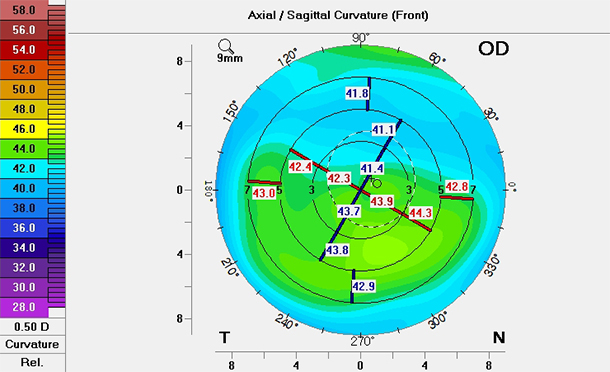
Before revision surgery: corneal irregularity and asymmetry
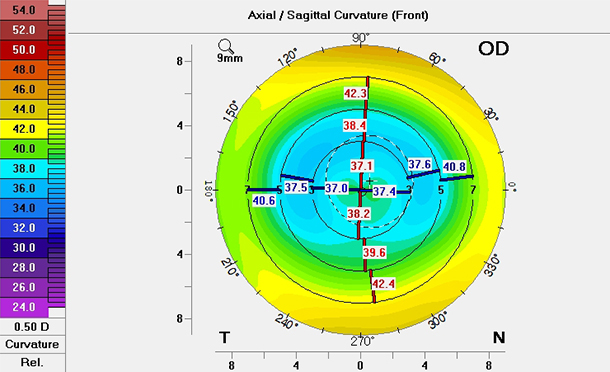
After revision surgery: improvement of corneal irregularity and asymmetry
FAQ
We consider it when vision is blurred, when part of the visual field is clear and part is not, when astigmatism is severe, or when decreased vision does not improve even with glasses. We do not decide based on symptoms alone; we use testing to identify the cause.
We start by finding the cause. Decreased vision may be due to the retina or optic nerve rather than the lens, so we don't advise on revision until the cause has been pinpointed.
Not necessarily. For residual refractive error, we first consider fine-tuning it with laser vision correction, without changing the lens. We decide after assessing corneal irregularity and asymmetry.
If the intraocular lens is dislocated from its normal position and vision declines, it can damage the retina, so an intraocular lens exchange is needed. We first check the position.
If the capsular support is healthy, we consider ciliary sulcus implantation; if the support is unstable, we consider scleral fixation. We determine which through testing.
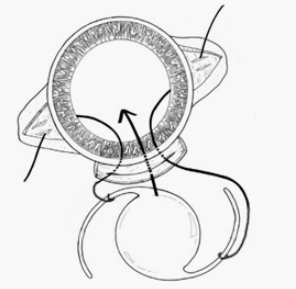
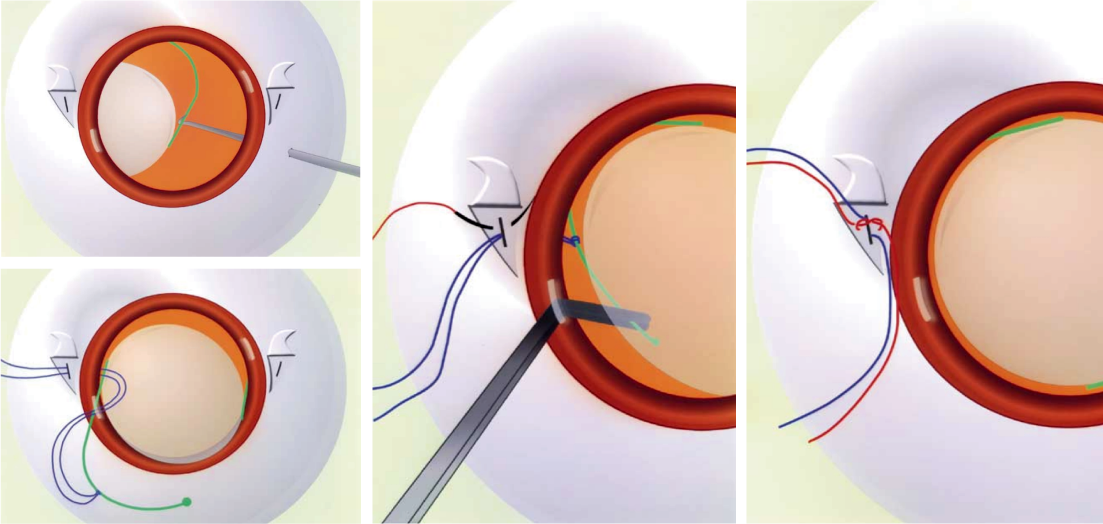
Sutures are tied to both haptics (support arms) of the intraocular lens and fixed to the sclera, holding the lens steady so it doesn't wobble or tilt.
When posterior capsular support is insufficient due to capsular aging, floppy iris syndrome, or a genetic condition, or when the posterior capsule has been removed after rupturing during surgery, we clear away the vitreous that has come forward through the posterior capsule and place the intraocular lens in the ciliary sulcus, in front of the anterior capsule.
We decide this at consultation. We test to see which lens was originally implanted and the condition of the support structures, then determine the method.
We re-examine the cause. If it involves the retina or optic nerve rather than the lens, we will address that condition first.
We first look for the cause. People who are sensitive to halos and glare, those whose glaucoma has progressed with decreased contrast sensitivity, those with retinal diseases such as macular degeneration or macular pucker, and those whose pupils are congenitally very small or very large may feel discomfort with a multifocal lens. We confirm the cause through testing and discuss next steps during consultation.
With a monofocal intraocular lens, focus is set for distance, so you may need glasses for near print. For people who read often or do a lot of close work such as cooking, we explain this before surgery. If you have already had surgery, we test your current prescription and eye condition and discuss options at consultation.
If a cataract is progressing, we first consider cataract surgery with a multifocal intraocular lens rather than Presbyopic LASIK. Rather than doing both together, we set the order according to how far the cataract has progressed.
You can still receive consultation and testing without records. We check the intraocular lens power and position and the corneal condition, identify the cause, and then guide you to the next steps.
After cataract surgery, some may experience issues such as incorrect intraocular lens power, dislocation, or opacification. We confirm which it is with testing, then decide whether to change the lens, refine with laser, or reposition it.


