




FAQ
Revision surgery is not a procedure that simply restores 1.0 (20/20) vision. We first find the cause of the decline and treat it accordingly; when correction becomes necessary, we decide the method then. We do not promise a specific level of vision.
We do not. At Gangnam Central Eye Clinic, even revision surgery for patients who had LASIK is performed using the surface-ablating LASEK approach.
It depends on residual corneal thickness and the cause of the decreased vision. Because the procedure does not create a corneal flap, the method is determined after reviewing the test results, and we cannot say whether it is possible without an examination.
Yes. We start with testing. After checking residual corneal thickness and corneal shape, and identifying the cause of the decreased vision, we let you know whether another surgery is possible.
Revision consultation begins with testing. We measure in five categories and review the results with you. We cannot determine candidacy before reviewing the results.
It means we do not recommend re-ablating. There is an option of placing a lens inside the eye without further corneal ablation; we review this together based on your measurements.
Whether revision surgery is possible, and on what conditions, is explained at your consultation.
Not automatically. If dry eye or an eye disease is the cause, we treat that first.
No. For those who had LASEK, revision is performed in the same way, and the criteria for decision-making are the same as for LASIK revision.
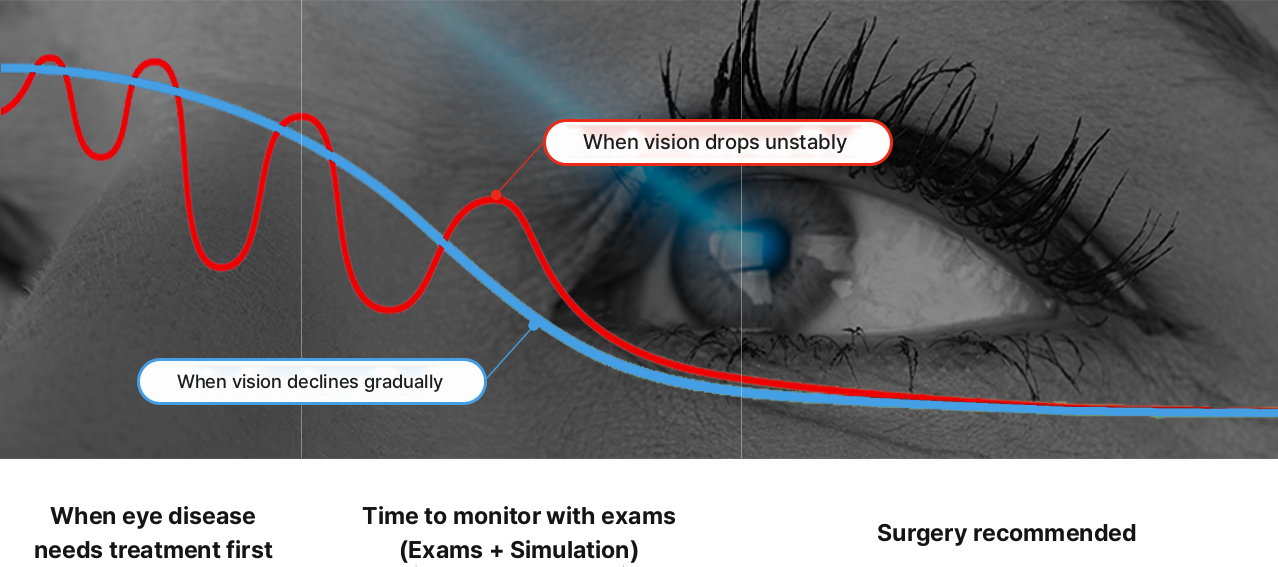
It is premature to decide before refraction stabilizes. We check at 1 month to see if refraction has stabilized, and wait until the 3-month examination before discussing. If the decrease in vision is ongoing, it may be better to wait longer.
Records help us decide more quickly, but even without them there are items we can verify by examination. We measure your current eyes to check residual corneal thickness, the curvature difference between the ablated zone and normal cornea, and corneal flap thickness.
Whether revision surgery is possible, and on what conditions, is explained at your consultation. If your first surgery was done at another clinic, we review your records and examination results at the consultation.
If regression is still progressing, it may be better to wait longer. Everyone has an optimal time; we determine it after testing confirms whether the progression has stopped.
No. We assess feasibility by examining residual corneal thickness and shape, the cause of decreased vision, and the ablation range from the first surgery. If testing indicates it is not suitable, we do not recommend revision. We cannot state feasibility without test results.
At our clinic, we proceed with the LASEK method. However, depending on the residual corneal thickness and the prior ablation range, we may advise differently; the method is determined after reviewing the test results.
Our testing includes corneal flap thickness, so we can tell whether a flap was created in the first surgery. Even just telling us roughly when it was done is helpful.
We first determine whether the decreased vision is due to myopic regression, a retina/optic nerve problem, or early cataract. If the cause differs, the evaluation and treatment plan that follow change entirely.
Thickness is the first hurdle, but not the only one. We also look at the laser treatment zone and centration from the first surgery, and the curvature difference between the treated area and the untreated cornea.
Whether revision surgery is possible is judged on its own, based on the remaining corneal thickness and the cause of the decline in vision. The conditions are explained at your consultation.
Testing is done in five categories: vision, glare and halos, cornea, dry eye, and retina.


